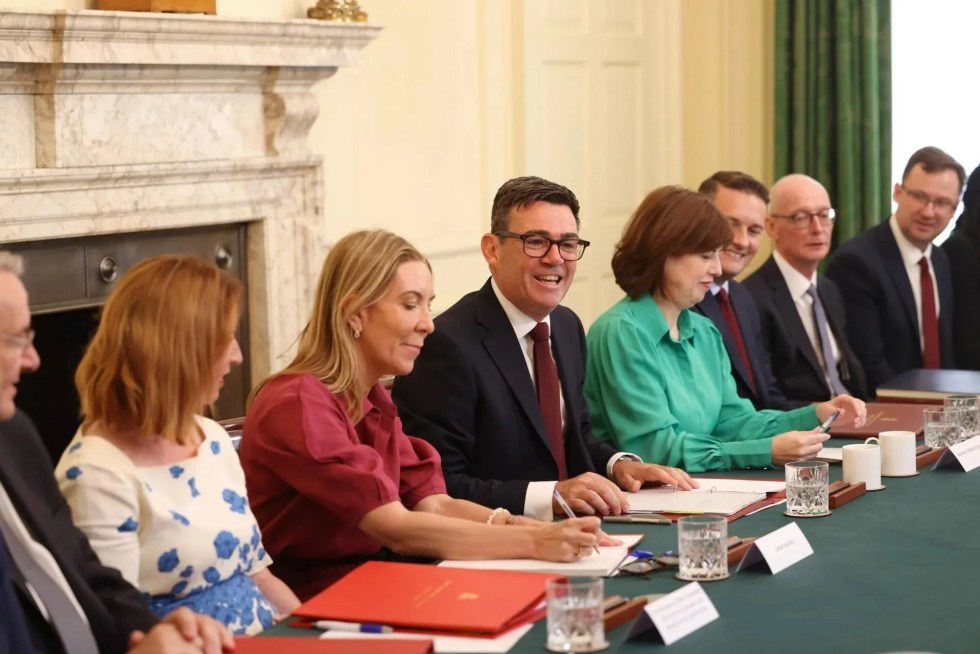
London (EFE).- British Prime Minister Andy Burnham presided over the first meeting of his cabinet on Tuesday, appointing political allies to key positions to advance his priorities, such as decentralizing power and implementing cost-of-living relief measures.
Although there has been a change in leadership at Downing Street, much of Keir Starmer’s team remains, with several ministers taking on new responsibilities within the government.

Louise Haigh, who served as Secretary of State for Transport from July to Nov. 2024, will now be responsible for coordinating the government’s actions and supporting the implementation of Burnham’s political agenda as Deputy Prime Minister. Haigh shares political roots with Burnham in northern England and backed him during the Labour leadership campaign.
John Healey, Minister of the Treasury, «Chancellor of the Exchequer,» takes over at the Treasury after serving as Minister of Defense under Starmer. Healey resigned from that position in protest at the defense sector’s underfunding under the former prime minister.
He has experience at the Treasury, where he served as Economic Secretary and later as Financial Secretary from 2002 to 2007 during Tony Blair’s administration.
Healey and Burnham have identified economic stability within fiscal rules as one of their priorities, along with measures to reduce citizens’ bills, increase public housing construction, and bolster the British industrial base.
Ed Miliband is leaving the energy portfolio, which he has held since Labour came to power in 2024, to become Foreign Secretary. His name was also mentioned for the role of Chancellor of the Exchequer.
He served as Leader of the Labour Party from 2010 to 2015 and as Secretary of State for Energy and Climate Change from 2008 to 2010 during Gordon Brown’s government, a role he returned to under Starmer.
Close to Burnham, whom he supported during the leadership campaign, Miliband has advocated for a foreign policy centered on respect for international law, closer ties with the European Union, strengthening relations with the United States, and upholding commitments to international organizations such as the United Nations.
Shabana Mahmood remains Home Secretary, a position she has held since Sep. 2025. She joined Starmer’s government as Justice Secretary.
Wes Streeting, a lawyer by training, has led the Labour government’s immigration policy. He implemented measures to strengthen controls on irregular migration and reduce arrivals through the English Channel.
Streeting, the new Minister of Defense, took over after resigning in May as Minister of Health in an attempt to force Keir Starmer out as leader of the party and head of the government.
His appointment places him at the forefront of one of the new government’s main challenges: fulfilling the commitment to gradually increase military spending to three percent of GDP over the next parliamentary term and covering the funding shortfall in the Armed Forces’ modernization plan inherited from the previous administration.
Yvette Cooper, the new Minister of Health, takes over after leading the Home Office and the Foreign Office. Her main challenges will be reducing waiting lists in the National Health Service and revitalizing the social care system.
She previously served as Minister of Work and Pensions from 2009 to 2010 during the Brown administration.
Miatta Fahnbulleh takes over as Minister of Energy following Ed Miliband’s move to the Foreign Office. In this role, she will need to address energy costs and the transition to renewable energy.
Jonathan Reynolds has been reinstated as Business and Trade Secretary, a key role in the reindustrialization and investment support strategy.EFE
jm/dgp