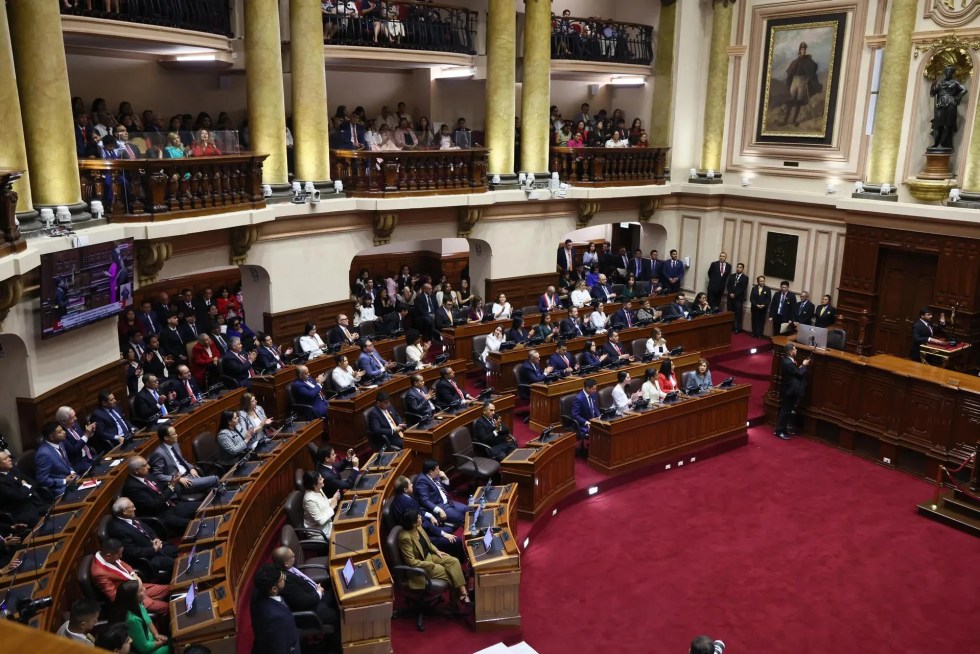
Lima (EFE).- Peru reinstated a bicameral parliament after nearly a quarter-century of operating under a unicameral congress, which became the epicenter of the political instability over the past decade, in which the country has had eight presidents in 10 years.
The new parliament, composed of a Senate and a Chamber of Deputies, has 60 senators and 130 deputies who were elected in the Apr. 12 and 13 elections and were sworn into office on Friday for the 2026-2031 term.

President Elect Keiko Fujimori will preside over this term and will be inaugurated in a ceremony on Tuesday, Jul. 28, Peru’s National Day.
Peru has not had a bicameral parliament since former President Alberto Fujimori (1990-2000), Keiko Fujimori’s father, carried out a “self-coup” on Apr. 5, 1992.
He dissolved the legislature and took control of the judiciary to govern by decree until a Constituent Assembly was established to draft the 1993 Peruvian Constitution, which provided for a unicameral Congress.
In 2018, a referendum was held on a series of political reforms, including a return to a bicameral system.
However, the «No» vote won with 90.51% of valid votes, as members of Congress included a provision that allowed them to alternate between the two chambers and circumvent the reform prohibiting reelection.
Despite being rejected by the popular vote, the Congress that concluded its term a few days ago managed to build sufficient consensus among its members to amend the Constitution two years ago and establish a bicameral legislature without the need for a new referendum, which they would likely lose given that the legislature’s approval rating does not exceed 5% of the population.
As of Friday, the senators were the first to be sworn in, and the Senate will hold all legislative power because it has the authority to amend bills referred to it by the Chamber of Deputies.
Currently, the Senate is evenly divided, with 30 senators affiliated with right-wing parties and 30 with centrist and left-wing parties.
Fuerza Popular, aligned with Fujimori, has the largest representation with 22 senators. Next is Renovación Popular, a far-right party with eight senators. The centrist Partido del Buen Gobierno has seven senators.
A left-wing alliance formed by Juntos por el Perú (14), led by former presidential candidate Roberto Sánchez, who lost the presidential runoff, as well as Obras (5) and Ahora Nación (4), stands on the other side.
In the Chamber of Deputies, 56 seats are held by Fuerza Popular (41) and Renovación Popular (15), the same number held by Juntos por el Perú (32), Obras (14), and Ahora Nación (10) collectively, and the Partido del Buen Gobierno holds 18 seats. EFE
fgg/dgp/mcd