Liuboml, Ukraine, Aug 1 (EFE).- The exhumation of victims of the Volhynia killings (the deaths of tens of thousands of Poles at the hands of Ukrainian nationalist groups in 1943) helps intensify dialogue between Poland and Ukraine after the flare-up of tensions over historical memory.
Sunflower fields and forest cover what used to be the villages of Ostrówki and Wola Ostrowiecka, in what is now Ukraine’s northwestern Volhynia region. More than a thousand Poles lived in the villages and hundreds were killed over 80 years ago.

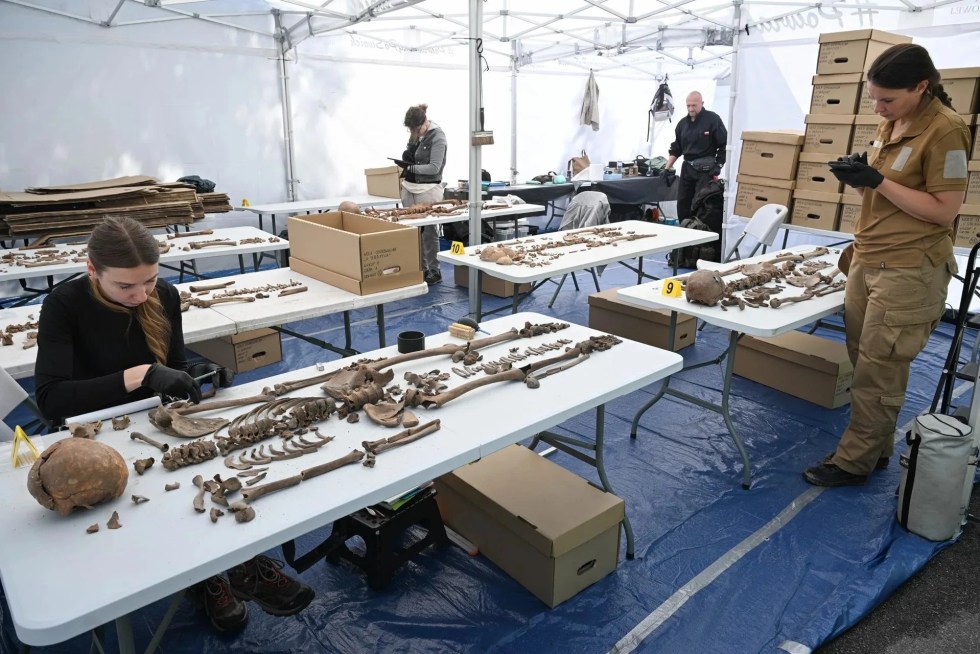
White tents stand out against the yellow and green landscape. One covers a recently uncovered grave where several remains are visible as archaeologists carefully sift the soil, determined not to miss even the smallest bone.
Seeking closure
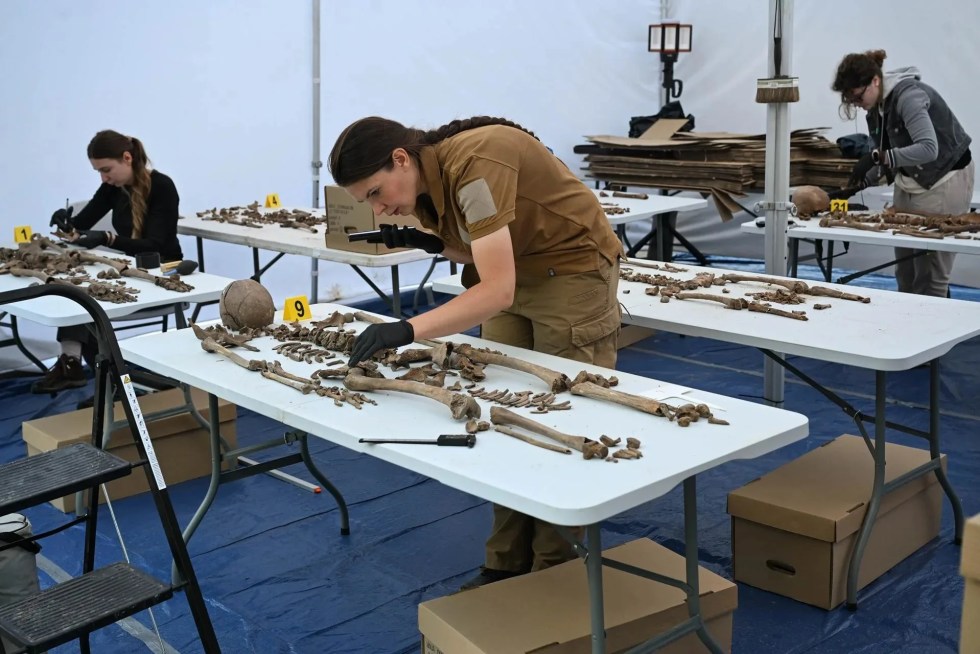
Forty-nine bodies have been recovered from mass graves so far in this latest round of joint excavations by Polish and Ukrainian specialists.
The work is expected to bring closure for the descendants of those killed and ease tensions that flared after President Volodymyr Zelenskyy named a special forces unit after the UPA, the Ukrainian Insurgent Army.
Poland holds the UPA responsible for the killings; in Ukraine the organization is remembered mainly for its desperate fight against Soviet occupation.
In June, Polish President Karol Nawrocki revoked the Order of the White Eagle previously awarded to Zelenskyy and vowed to block Ukraine’s European Union accession unless Kyiv condemns the UPA.
“Truth gives start to the dialogue and search for unity,” Leon Popek, a Polish historian whose grandfather was killed at this site, told EFE near the tents where the bodies are analyzed by the binational team. “We have great relations. We see how delicately and relentlessly the Ukrainians bring up these remains. I wish this example could serve for wider Polish-Ukrainian relations.”
Permission for the current work was granted quickly by Ukraine and 14 further requests are pending, said Karol Polejowski, deputy head of Poland’s Institute of National Remembrance, who attended a memorial Mass at the site on Tuesday. “We put our hopes on the promise by President Zelenskyy to speed up the permits,” he said.
Hope and caution
“We welcome such works. The more we know, the less space there is for lies,” a representative of the local Ukrainian authorities, who asked to remain anonymous, told EFE.
“Yet it worries me how politicians in Poland use this,” he added, pointing to fears that the Instrumentalization of a historical issue is fueling anti-Ukrainian sentiment in a country hosting more than a million displaced Ukrainians.
Residents of this border area regard Poles as neighbors and partners, he says, and the current criticism from Poland feels especially inopportune while Ukrainians mourn the victims of the Russian invasion and fight for the country’s survival.
Even though few deny the killings took place, many reject what they see as an attempt to impose a one-sided reading of history without examining the causes of the Volhynia Tragedy, as the events are known in Ukraine.
Research needed
“It is our duty to bury and honor the victims. At the same time we must understand exactly what happened before making definite conclusions, that is the work of historians,” Yaroslav Onyshchuk, a representative of Ukraine’s Institute of National Memory, told EFE at the excavation site.
Polish estimates place the number of Polish victims in between 100,000 and 130,000. Ukrainian and some Western sources cite lower numbers for Polish casualties and note that up to 20,000 Ukrainians were also killed.
Poland classifies the events as genocide; Ukraine rejects that term and emphasizes mutual violence in a complex wartime setting that included Soviet and Nazi forces. The Soviets, Ukrainian historians say, deliberately fueled a spiral of violence between Poles and Ukrainians and now Russia seeks to do the same.
Onyshchuk hopes excavations of Ukrainians killed by Polish militias and buried without proper rites can one day take place across the border. “Objective research should continue in both countries so that past mistakes are never repeated,” he underlined. EFE
ra/dmv