
![[FILE] A Danish airforce personnel walking on the tarmac next to Danish F-16 aircraft at the Nato airbase in Sigonella, Catania region, Sicily island, Italy, 20 March 2011. EPA/ORIETTA SCARDINO](https://i0.wp.com/efe.com/wp-content/uploads/2026/08/rss-efed9a561e815bd18f98018cf53c034e40c3d5f7aa0w.webp?fit=1920%2C1169&ssl=1)
Riga/Moscow, Aug 14 (EFE).- An Italian fighter jet assigned to NATO’s Baltic Air Policing mission shot down a drone over northeastern Latvia on Friday after the aircraft entered Latvian airspace, apparently after being diverted from its course by Russian electronic warfare, Latvian authorities said.
The alert was activated at around 4 a.m. local time (1 a.m. GMT), prompting the emergency deployment of two Italian Eurofighter jets. One of them shot down the drone, NATO spokesperson Allison Hart told EFE.

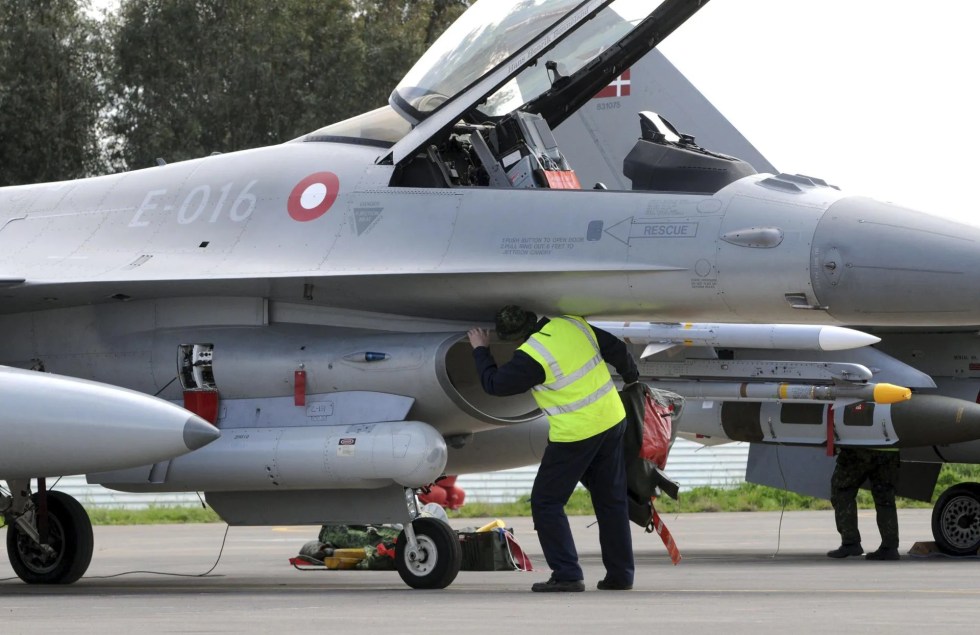
Two Turkish F-16 fighter jets also took off in response to the alert.
The Italian fighter shot down the drone in the Balvi region of northeastern Latvia, where several dozen members of the Latvian National Guard were searching for debris to determine the aircraft’s origin.
According to the Latvian Armed Forces, the drone was diverted from its course by Russian electronic warfare.
Latvian Defense Minister Raivis Melnis told public broadcaster LSM that the decision to shoot down the drone was made to prevent it from endangering the population.
Prime Minister Andris Kulbergs thanked Latvia’s armed forces and NATO allies for their “professional and operational action” in destroying the drone, but declined to speculate on its origin.
A possible Ukrainian drone
The drone was detected by all three Baltic states, which have experienced several drone crashes and airspace incursions in recent months, particularly as Ukraine has stepped up attacks on Russian targets far behind the front lines.
Vilmantas Vitkauskas, head of Lithuania’s Crisis Management Centre, said Friday that the drone was likely Ukrainian.
“The drone, possibly Ukrainian, was affected by Russian electronic warfare, deviated from its course and entered NATO airspace, specifically Latvian territory, presumably coming from Belarus,” Vitkauskas said, according to Lithuanian public broadcaster LRT.
Around the same time that NATO fighter jets took off from Šiauliai Air Base, a major Lithuanian military facility and one of the bases used for NATO’s Baltic Air Policing mission, Finland’s Defense Forces further north imposed temporary air and maritime restrictions.
Ukrainian attack on Russian port
The incident coincided with a large-scale Ukrainian drone attack on the Russian port of Ust-Luga, one of the largest ports on the Baltic Sea.
Leningrad region Governor Alexander Drozdenko said on Telegram that 54 drones had been shot down in the region and that a fire had broken out at the port of Ust-Luga.
Ukraine confirmed after midday that its forces had carried out the overnight attack on the Novatek-Ust-Luga gas complex operated by Russian energy company Novatek. Kyiv said two gas-processing units had been damaged.
The Ukrainian General Staff said the complex’s products are used in Russia’s military-industrial activities and help meet the needs of the Russian armed forces.
Ukrainian forces have repeatedly targeted Russian ports, oil refineries, gas facilities and petrochemical plants far from the front lines in an attempt to disrupt the war effort and the revenues that finance Moscow’s invasion of Ukraine.
Ukraine has also carried out attacks targeting Wildberries, Russia’s largest online retailer, accusing the company of storing military supplies and components for drones.
Russia, in turn, has carried out repeated attacks with drones and ballistic missiles against Kyiv and the Ukrainian port city of Odesa on the Black Sea.
Against this backdrop, Russian Foreign Minister Sergey Lavrov said Friday that Moscow had asked Washington for explanations over the alleged transfer of intelligence to Ukraine that, according to Russia, enables attacks on civilian targets in the Russian rear. EFE
cae-jkz-mos-rja-sk




![[FILE] A Danish airforce personnel walking on the tarmac next to Danish F-16 aircraft at the Nato airbase in Sigonella, Catania region, Sicily island, Italy, 20 March 2011. EPA/ORIETTA SCARDINO](https://i0.wp.com/efe.com/wp-content/uploads/2026/08/rss-efed9a561e815bd18f98018cf53c034e40c3d5f7aa0w.webp?fit=300%2C183&ssl=1)


